

At Coventry Direct, we know financial questions rarely stay theoretical for long. They show up when someone is comparing mortgage costs, trying to build savings, filing taxes, or deciding how much is enough for retirement. And before many people talk with an advisor, they open Google.
To see which personal finance topics captured the most interest around the country, we analyzed Google Trends data from the past 12 months and identified the top-performing money question and money term in each state and the District of Columbia. Because Google Trends measures relative search interest rather than raw search volume, the results below show which topic over-indexed most in each geography among the tracked set of finance queries.
The Most Googled Money Question in Every State
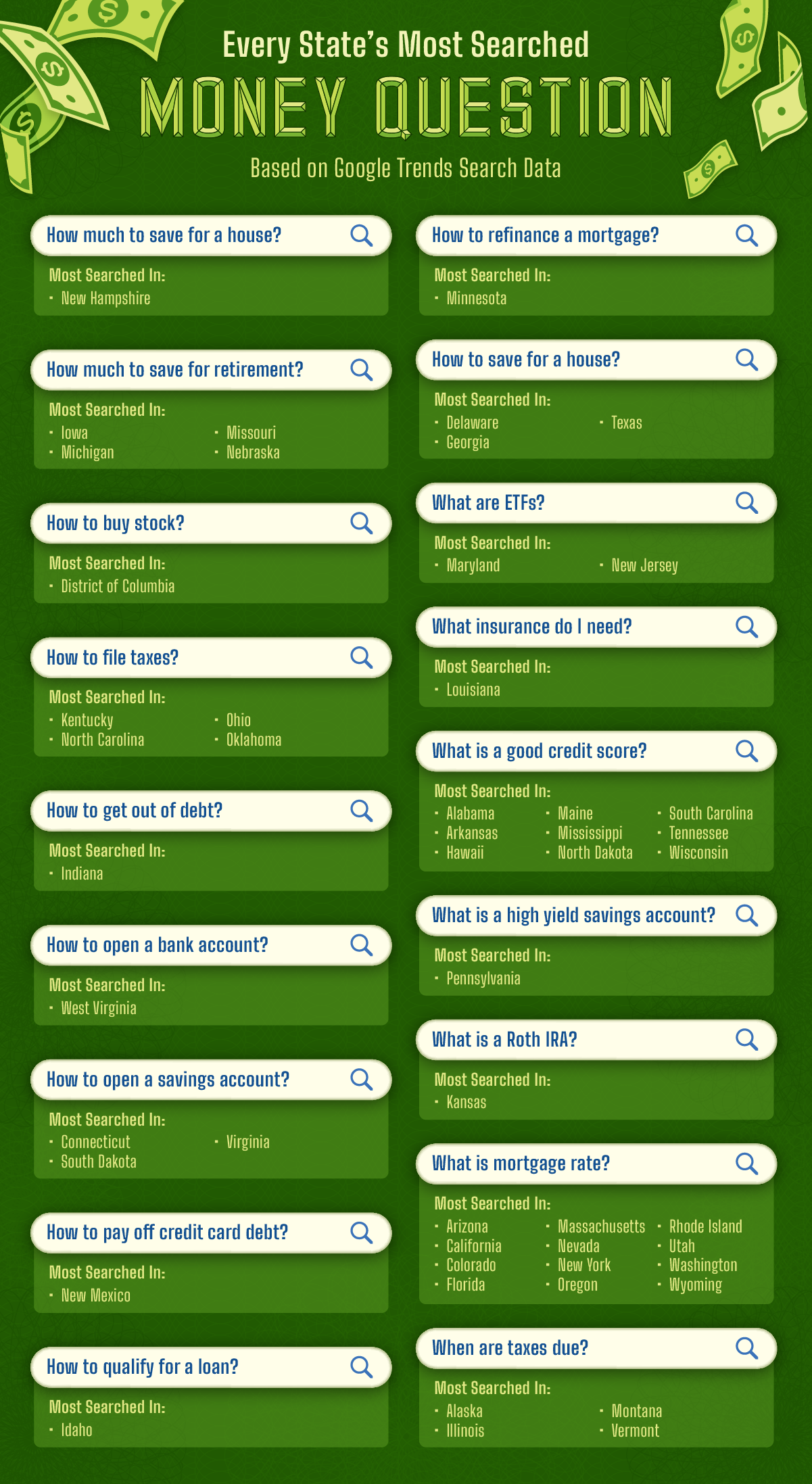
The question data points to a country focused on practical decisions, especially around housing. “What is mortgage rate?” was the top question in 12 states, making it the most-searched question overall.
When you layer in related home-focused searches like “How to save for a house?,” “How much to save for a house?,” “How to refinance a mortgage?,” and “How to qualify for a loan?,” housing-centered questions led in 18 of the 51 states.
Credit health was another major theme, with “What is a good credit score?” ranking first in 9 states, while tax-related questions also showed up repeatedly. Regionally, the Midwest leaned more toward retirement planning, while the South over-indexed on credit score questions.
Quick Answers to the Most Googled Money Questions
What is mortgage rate?A mortgage rate is the interest a lender charges on a home loan. It affects your monthly payment and the total amount you will pay over the life of the loan.
What is a good credit score?A good credit score is generally considered to be in the 670 to 739 range, though higher scores can help you qualify for better rates and loan terms. Lenders use credit scores to assess how risky it may be to lend money.
When are taxes due?Federal income taxes are due on April 15, 2026 for most individual filers. You can request an extension to file, but any taxes owed are still generally due by the original deadline.
How much should you save for retirement?The amount you should save for retirement depends on your age, income, lifestyle goals, and expected retirement date. A common rule of thumb is to save enough to replace a meaningful portion of your income over time, but individual needs can vary widely.
How do you file taxes?You can file taxes by submitting your federal and, if required, state tax returns online, through tax software, with a tax professional, or by mail. The process generally involves reporting your income, claiming deductions or credits, and calculating what you owe or should receive as a refund.
What are ETFs?ETFs, or exchange-traded funds, are investment funds that hold a basket of assets such as stocks or bonds and trade on an exchange like a stock. They are often used to help investors diversify their portfolios.
The Most Googled Financial Term in Every State
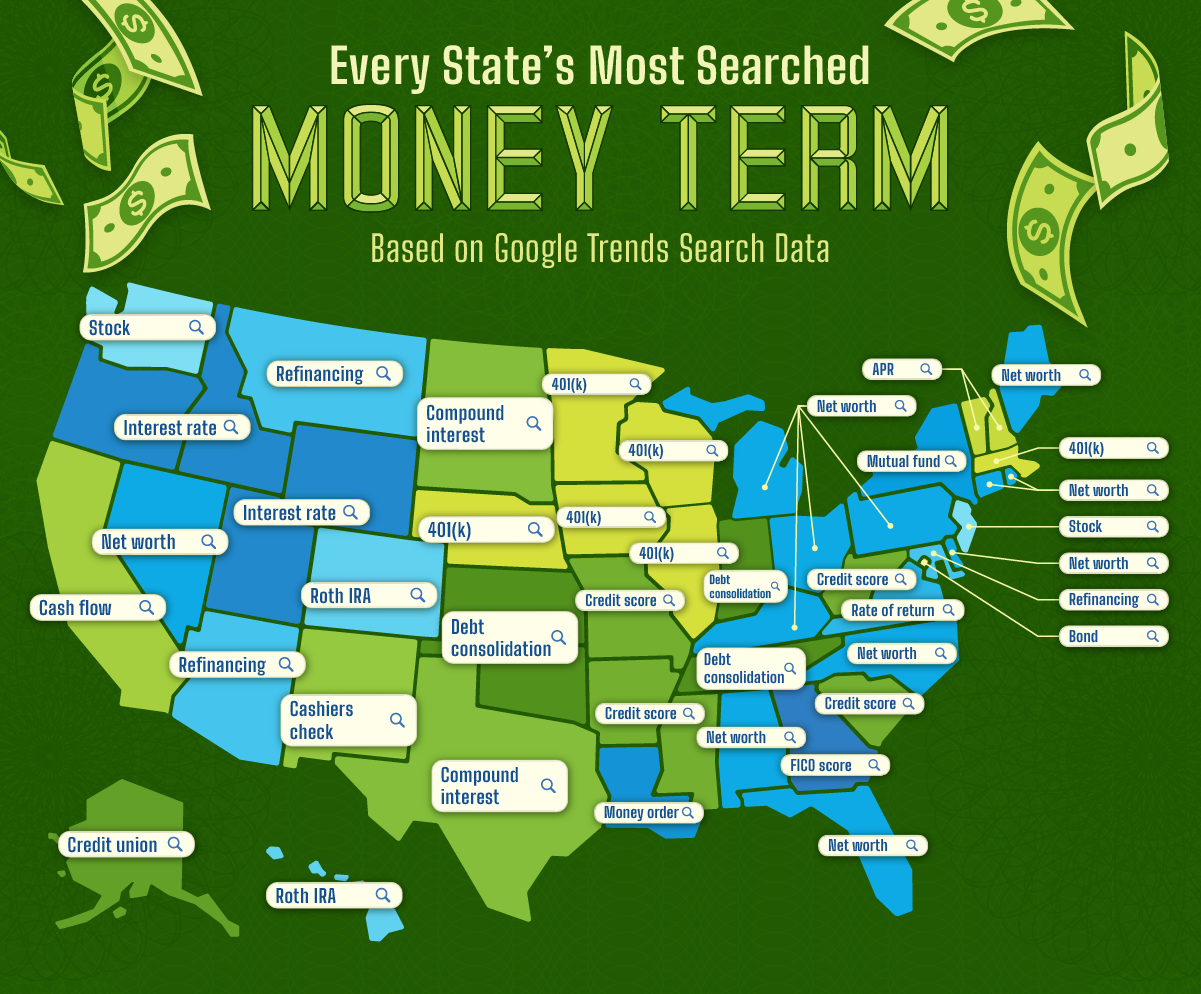
The term data shows a parallel need: not just answers, but context. “Net worth” was Googled first in 12 states, more than any other term in the study, suggesting that many searchers are trying to benchmark their overall financial position.
Retirement language was also prominent, with “401(k)” ranking first in 6 states and leading the Midwest. At the same time, terms tied to borrowing and repayment, including “Interest rate,” “Debt consolidation,” “Credit score,” and “Refinancing,” appeared again and again.
In other words, people are not only searching for what to do with their money; they are trying to understand the vocabulary behind the decisions in front of them.
Common Financial Terms, Explained
Net worthNet worth is the total value of what you own minus what you owe. It is often used as a simple way to measure overall financial health.
401(k)A 401(k) is an employer-sponsored retirement savings plan that lets workers contribute money from their paycheck, often with tax advantages. Some employers also offer matching contributions.
Credit scoreA credit score is a number that reflects how likely you are to repay borrowed money based on your credit history. Lenders use it to help decide whether to approve loans and what rates to offer.
Interest rateAn interest rate is the percentage a lender charges to borrow money or a bank pays on savings. It plays a major role in the cost of loans and the growth of savings.
Debt consolidationDebt consolidation is the process of combining multiple debts into one payment, often through a new loan or balance transfer. The goal is usually to simplify repayment or secure a lower interest rate.
RefinancingRefinancing means replacing an existing loan with a new one, usually to get a lower interest rate, reduce monthly payments, or change the loan term. It is commonly used for mortgages, auto loans, and student loans.
Compound interestCompound interest is interest earned on both the original amount of money and any interest already added. Over time, it can help savings grow faster.
Roth IRAA Roth IRA is an individual retirement account funded with after-tax money. Qualified withdrawals in retirement are generally tax-free.
Closing Thoughts
At Coventry Direct, we believe better financial decisions start with clear, straightforward information. The search trends in this report highlight how many people are actively looking for guidance on major financial milestones, from managing debt to planning for retirement.
For some policyowners, life insurance is part of that broader financial picture. If your coverage no longer fits your needs, the premiums have become harder to manage, or you want to explore whether your policy may have value today, a life settlement may be worth considering.
Methodology
We began with a list of 52 common money-related questions and financial terms and analyzed each one in Google Trends using state-level search interest data from the past 12 months. We then identified the top searched money question and top searched financial term in every state based on relative search interest.
Because Google Trends indexes search activity on a relative scale, the findings reflect comparative popularity rather than raw search volume. In other words, the results show which money questions and terms generated the greatest share of search interest in each state over the last year.
Fair Use
You are welcome to use, reference, and share non-commercial excerpts of this study with proper attribution. If you cite or cover our findings, please link back to this page so readers can view the full methodology, charts, and context.
