

Some people jump out of bed before the sun comes up, ready to tackle the day before most people have poured their first cup of coffee. Others don’t really get going until the evening, finding their energy long after the rest of the world starts winding down. Whether you’re an early bird or a night owl, everyone seems to have a natural rhythm.
That got us wondering whether those rhythms change depending on where you live. To find out, we surveyed Americans across the country about their sleep schedules, daily routines, morning and nighttime habits, and when they feel most productive. We analyzed those responses to determine which states are home to the most early birds and which are filled with night owls.
So, who’s greeting the sunrise, and who’s still wide awake after midnight? Let’s take a look at how America’s daily routines compare from coast to coast.
Is Your State an Early Bird or a Night Owl?
Whether you’re out for a sunrise walk or settling in for a midnight movie, everyone has a part of the day when they feel at their best. Our survey found those preferences aren’t evenly distributed across the country, with some states clearly leaning toward mornings while others come alive after dark.
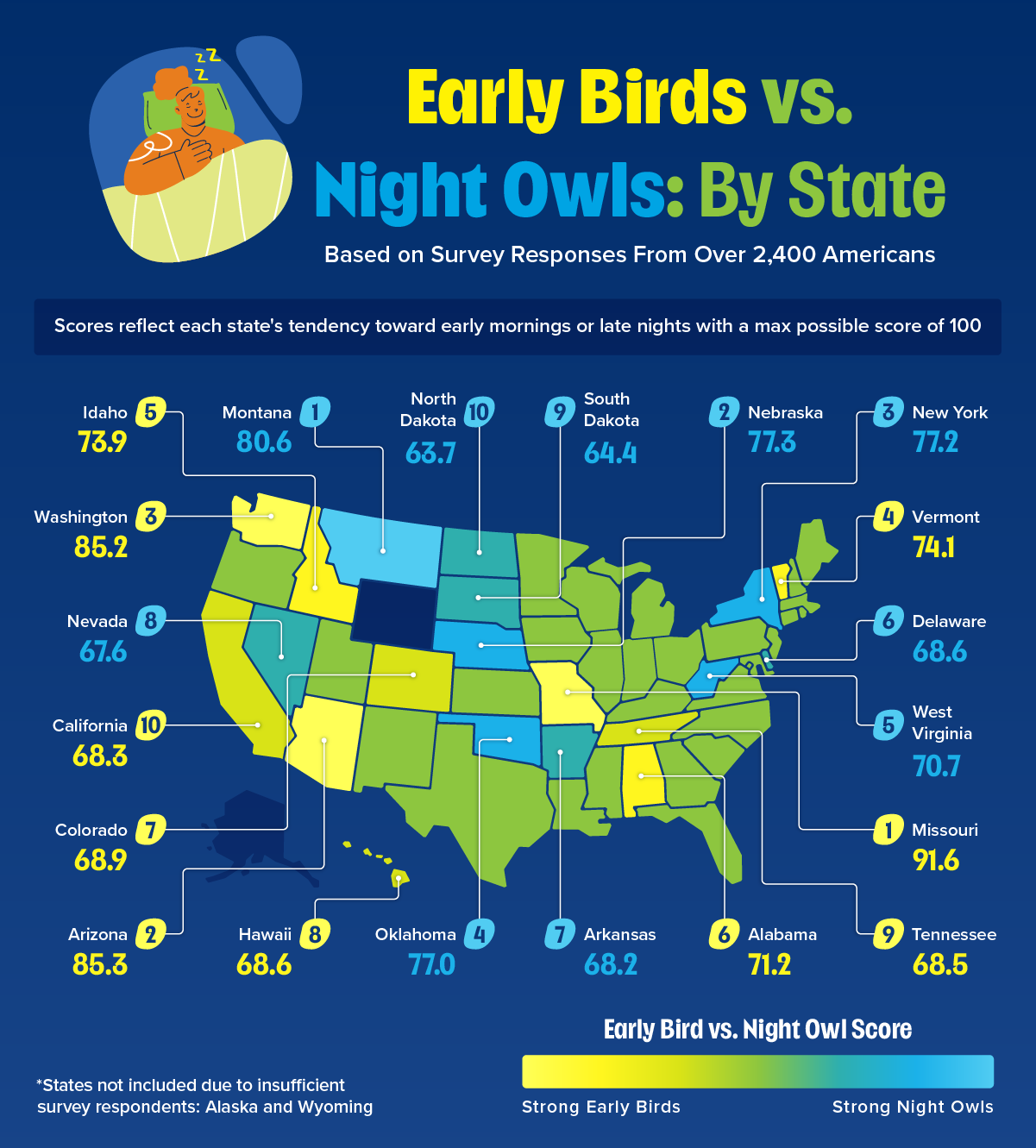
States Home to the Most Morning People
The following states earned the highest Early Bird Scores based on residents’ daily routines, energy levels, sleep schedules, and morning preferences:
- Missouri — 91.55
- Arizona — 85.25
- Washington — 85.17
- Vermont — 74.12
- Idaho — 73.89
Missouri separated itself from the rest of the country as the strongest early bird state by a pretty wide margin. The state posted strong morning habits across nearly every survey question, but really stood out as the place where people report going to bed the earliest on both weekends and weekdays. Additionally, more than 68% of Missourians said they feel most alert in the morning, compared to 56% nationally.
Arizona and Washington showed similar patterns for appreciating an early start to the day. 69% of Arizonans told us they typically wake up before 7 a.m. on workdays, with 52% doing so even on their days off. That’s about 10–15% higher than the national average for both questions. Washington, on the other hand, stood out because of how they feel when they wake up. 64% enjoy the morning time from the moment they get out of bed, while many respondents told us it takes them a bit longer to get going when the alarm goes off.
The lone east coast state in our top five, Vermont, scored well because 71% say the morning is when they feel most alert, focused, and productive (compared to 55% nationally). Idaho followed closely behind, buoyed mostly by residents telling us they go to bed earlier and enjoy quiet mornings more than nearly every other state.
States Home to the Most Night People
These states received the highest Night Owl Scores, indicating residents are more likely to stay up later and feel their best after the sun goes down:
- Montana — 80.64
- Nebraska — 77.32
- New York — 77.18
- Oklahoma — 76.96
- West Virginia — 70.72
Montana comes in as the state with the most night owls. Residents reported the latest wake-up times in the country, with 39% waking up after 8 a.m. on workdays, 10% more than the national average. 63% also describe themselves as a night owl, which is about 20% more than any other state.
Nebraska was propelled to second place because 49% of residents say they feel most alert and productive in the evening, compared to the study-wide average of 29%. They also generally report feeling worse in the mornings than most other states.
New York, perhaps unsurprisingly, finished in the top three in our night owl ranking. They reported both the latest typical bedtime on both weekdays and weekends with 59% going to bed after midnight on days they work and 72% doing so on off days. Both are about 20% higher than the average answer in our study. The city that never sleeps is a reputation that is earned, not given.
Oklahoma and West Virginia round out the top five. Both report waking up on days off much later than other states with 68% of Oklahomans and 73% of West Virginians not getting their weekends started until after 8 a.m. Those are the highest marks in the study and well above the 53% study-wide average. Residents of these states aren’t exactly what you’d call early morning people.
While every state has its share of early risers and late-night enthusiasts, the rankings show that daily routines can vary considerably depending on where people live. Next, we’ll look beyond the state rankings to explore the survey findings that reveal how Americans spend their mornings, evenings, and everything in between.
America’s Daily Routines
While every state has its own rhythm, the survey also revealed some clear nationwide trends. Americans may not all agree on when the day starts or ends, but their routines paint an interesting picture of how mornings and nights fit into everyday life.
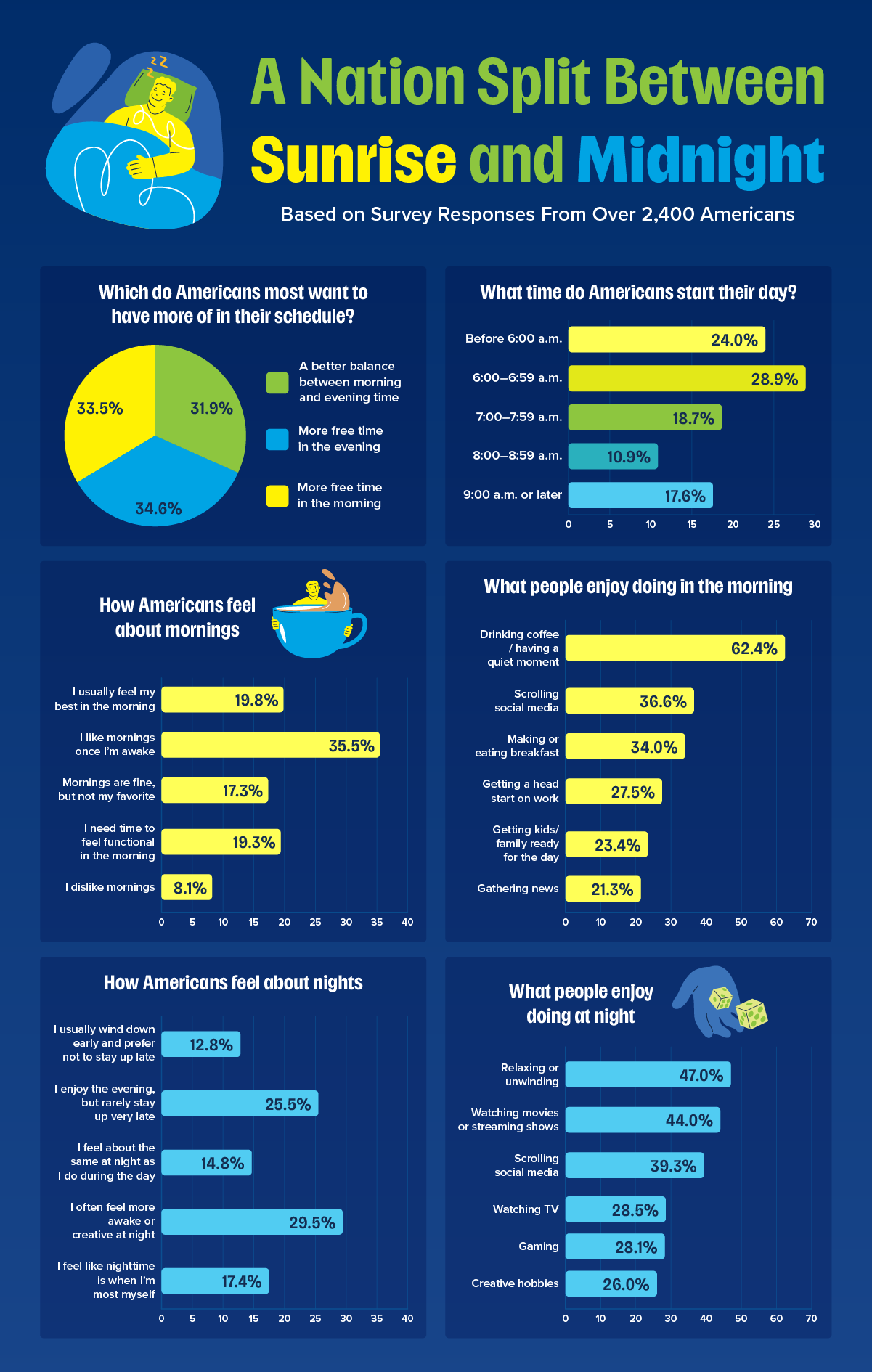
One of the biggest takeaways? Americans seem to aspire to be early birds, but many live more like night owls.
- 43% of respondents describe themselves as night owls, compared to 38% who identify as early birds.
- Yet when asked when they feel most alert, 56% said the morning, while just 29% said the evening or nighttime.
Even people’s schedules reflect this balancing act.
- 33% wish they had more personal time in the morning, 35% want more time at night, and 32% said they’d simply like a better balance between the two.
Many Americans appreciate what mornings have to offer, even if their natural tendencies or daily schedules keep them up later than they’d like.
Those competing priorities become even clearer when looking at typical sleep schedules.
- On a weekday, nearly 1 in 4 Americans (24%) wake up before 6 a.m., while 18% don’t get up until after 9 a.m.
- Weekends tell a different story. Just 10% wake before 6 a.m., while more than 1 in 3 (35%) sleep until after 9 a.m.
Bedtimes shift just as dramatically.
- The most common weekday bedtime falls between 10 and 11 p.m., but on weekends, the most common answer is 1 a.m. or later (33%). Only 17% still head to bed between 10 and 11 p.m.
Whether it’s catching up on sleep or enjoying a night without an alarm the next morning, weekends clearly give Americans permission to operate on a different schedule.
We also explored how people actually feel about the beginning and end of each day, and the results suggest most Americans aren’t particularly extreme in either direction.
- 36% said they like mornings once they’re actually awake, making it the most common response.
- 20% said mornings are when they feel their best.
- 19% admitted they need some extra time before they become fully functional.
Evenings produced a similarly balanced picture.
- 29% said they feel more awake or creative at night.
- 26% enjoy the evening but rarely stay up, especially late.
- 17% said nighttime is when they feel most like themselves.
In other words, while people may label themselves as early birds or night owls, many Americans seem to land somewhere in the middle, appreciating different parts of the day for different reasons.
When Americans do get extra time in the morning or at night, they tend to spend it in familiar ways.
Favorite early morning activities:
- Drinking coffee or enjoying a slow moment (62%)
- Scrolling social media (37%)
- Eating breakfast (34%)
Favorite late-night activities:
- Relaxing and unwinding (47%)
- Watching movies or TV (44%)
- Scrolling social media (39%)
One activity appears on both lists: scrolling social media. Whether Americans are easing into the day or winding it down, many reach for their phones. The biggest difference is the pace. Mornings tend to revolve around preparing for the day ahead, while evenings are more about relaxing before calling it a night.
There isn’t one “right” way to structure a day. Some people are most productive before sunrise, while others don’t find their groove until well after sunset. Regardless of when they feel at their best, most people are simply trying to carve out a little more time for themselves before the day begins or after it finally winds down.
Winding Down
Across the country, Americans may start and end their days in very different ways, but the same pattern shows up again and again: routines change, preferences shift, and there is no single right way to move through the day.
That mix of habits says a lot about how people live, work, and make choices over time. It is also a reminder that priorities can change, sometimes in ways that make old plans less useful than they once were.
That idea is something that Coventry Direct knows well. Just as people adjust their routines when life changes, they may also need to adjust financial plans that no longer fit their needs. When that happens, selling an unused life insurance policy can be one way to move forward with more flexibility.
Methodology
To determine which U.S. states are early birds and which are night owls, we surveyed more than 2,400 Americans from 48 states about their daily routines, sleep schedules, energy levels, and morning vs. nighttime preferences. The survey was conducted over two weeks in May 2026.
Our Early Bird vs. Night Owl Index is based on responses to 10 survey questions. Answers indicating stronger early bird tendencies received lower values, while answers indicating stronger night owl tendencies received higher values. For each question, average state responses were scaled from 0 to 10, with lower scores reflecting stronger early bird tendencies and higher scores reflecting stronger night owl tendencies.
Each question was weighted equally, and scores were combined to create an overall Night Owl Score. States scoring above 50 were ranked as night owls. States scoring below 50 were classified as early birds, and their scores were inverted to create an Early Bird Score for ranking purposes.
Alaska and Wyoming were excluded due to insufficient survey responses.
Fair Use
You are welcome to use, reference, and share non-commercial excerpts of this study with proper attribution. If you cite or cover our findings, please link back to this page so readers can view the full methodology, charts, and context.
