

Immigrant entrepreneurs play a profound role in shaping local economies across the United States. From family-run restaurants and independent retailers to tech startups and professional services, immigrant-owned businesses contribute jobs, innovation, and cultural diversity to the communities they serve.
According to the U.S. Census Bureau, 23.39% of businesses nationwide are owned by immigrants, demonstrating the essential role these entrepreneurs play in the country’s economic landscape. However, the concentration of immigrant-owned businesses varies significantly from city to city—reflecting differences in migration patterns, economic opportunities, and population diversity.
To better understand these dynamics, we analyzed the share of immigrant-owned businesses across the 100 largest U.S. metropolitan statistical areas (MSAs). A brief overview of our approach is included below, with the full methodology available at the end of this article.
Key Takeaways
- Miami, FL, leads with 61.81% of all businesses being immigrant-owned—nearly triple the national average.
- Jackson, MS, ranks last with only 5.36% immigrant-owned businesses, highlighting significant regional disparities.
- Many of the cities with the highest shares are located in Florida, California, and Texas, while the cities with the lowest shares tend to cluster in the Midwest and Southeast.
The U.S. Cities With the Most Immigrant-Owned Businesses
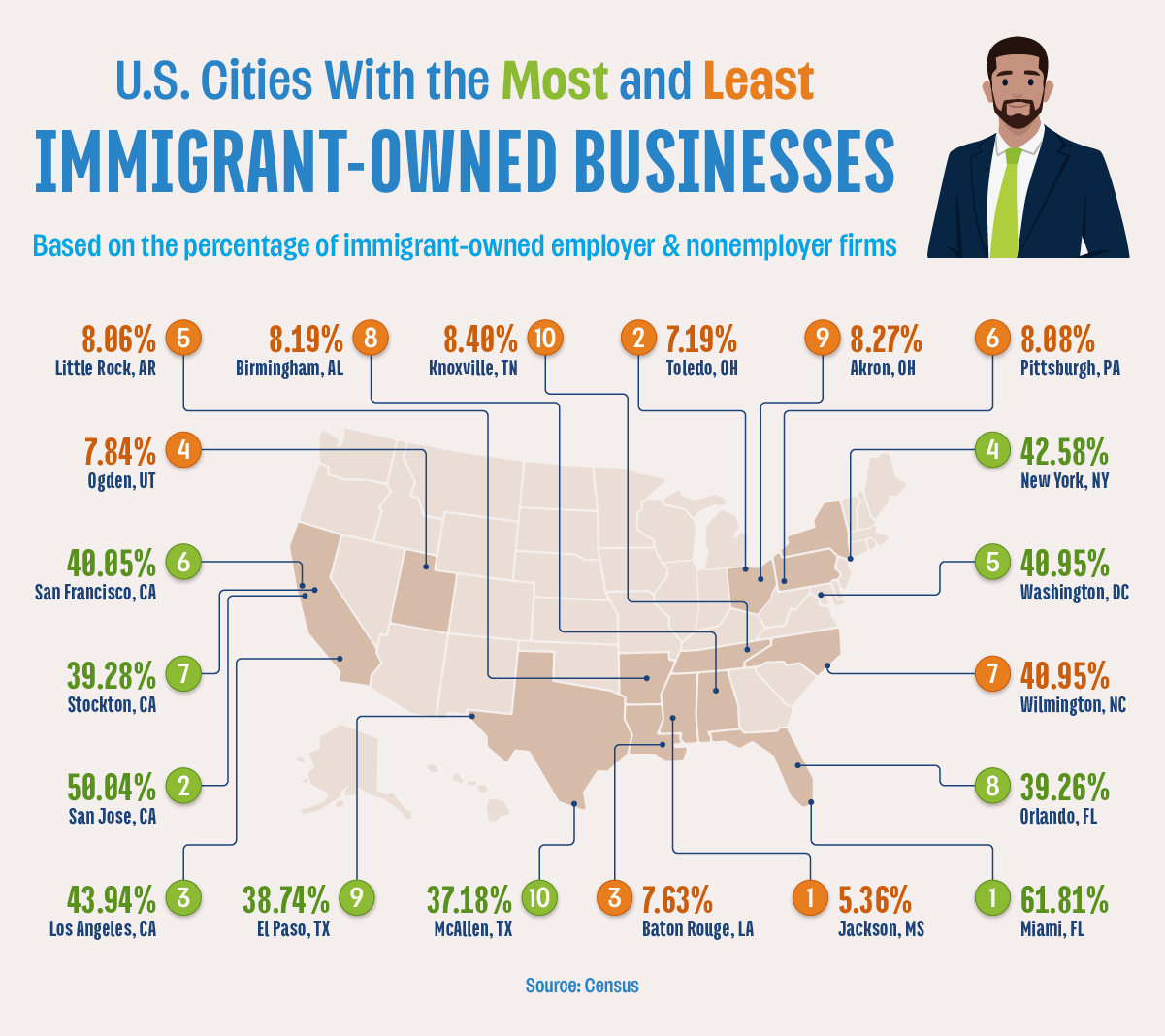
The map highlights the top 10 U.S. cities with the highest percentage of immigrant-owned businesses. Many of these metro areas are long-standing gateways for immigration or are home to rapidly growing populations fueled by global migration.
Top 10 Cities
- Miami, FL – 61.81%
- San Jose, CA – 50.04%
- Los Angeles, CA – 43.94%
- New York, NY – 42.58%
- Washington, DC – 40.95%
- San Francisco, CA – 40.05%
- Stockton, CA – 39.28%
- Orlando, FL – 39.26%
- El Paso, TX – 38.74%
- McAllen, TX – 37.18%
These cities share several characteristics that help foster immigrant entrepreneurship: strong industry diversity, well-established cultural communities, and access to economic opportunities that support business creation.
Cities like Miami and Los Angeles have long histories as international hubs, while places like Orlando and El Paso have seen significant recent population growth driven by migrant communities.
The U.S. Cities With the Least Immigrant-Owned Businesses
On the other side of the spectrum, several metro areas have comparatively low shares of immigrant-owned firms. These cities tend to be located in regions with slower immigration inflows, smaller startup ecosystems, or historically less population diversity.
Bottom 10 Cities
- Jackson, MS – 5.36%
- Toledo, OH – 7.19%
- Baton Rouge, LA – 7.63%
- Ogden, UT – 7.84%
- Little Rock, AR – 8.06%
- Pittsburgh, PA – 8.08%
- Wilmington, NC – 8.12%
- Birmingham, AL – 8.19%
- Akron, OH – 8.27%
- Knoxville, TN – 8.40%
Many of these cities are located in the Midwest and Southeast, regions where immigration levels have historically been lower. Industrial legacies, slower population growth, and economic restructuring may also influence the types of businesses being created—and who is creating them.
Trends and Regional Insights
- Coastal and Sun Belt cities dominate the top of the list
Florida, California, and Texas account for many of the highest-ranking metro areas, reflecting their population diversity and economic growth.
- Large economic hubs attract and support immigrant entrepreneurship
Cities such as Chicago (30%), Seattle (29.9%), and Washington, DC (41%) exceed the national average, aligning with their strong job markets and diverse industries.
- Midwest and Southeastern metros see lower representation
Cities including Toledo, Akron, Birmingham, and Jackson appear at the bottom of the list, highlighting regional differences in migration patterns and business formation.
- City size is not the primary factor
Smaller metro areas like McAllen, TX, and El Paso, TX rank ahead of much larger cities—showing that local culture, networks, and community roots matter as much as population scale.
Closing Thoughts
Immigrant-owned businesses are vital contributors to local economies, shaping neighborhoods, strengthening job markets, and adding cultural vibrancy to communities across the country. The geographic differences highlighted in this study show how entrepreneurship is influenced by local opportunity, population diversity, and the economic evolution of individual regions.
As cities continue to grow and change, many Americans find themselves reevaluating their financial futures and long-term plans. If you’re exploring your financial options or want to understand the value of your life insurance policy, Coventry Direct provides resources and guidance to help you make informed decisions. Learning about life settlements can be an empowering part of planning for the next chapter—no matter where you call home.
Methodology
To identify both the cities with the most immigrant-owned businesses and the cities with the most immigrant-owned independent businesses, we analyzed data from the U.S. Census Bureau’s Annual Business Survey (ABS) for the 100 largest metropolitan statistical areas (MSAs).
For each MSA, we pulled counts of employer and nonemployer firms and identified which were owned by individuals born outside the United States. We then calculated the share of immigrant-owned firms by comparing the number of immigrant-owned businesses to the total number of businesses in each MSA.
Fair Use
You are welcome to use, reference, and share non-commercial excerpts of this study with proper attribution. If you cite or cover our findings, please link back to this page so readers can view the full methodology, charts, and context.
